 Admin
Admin 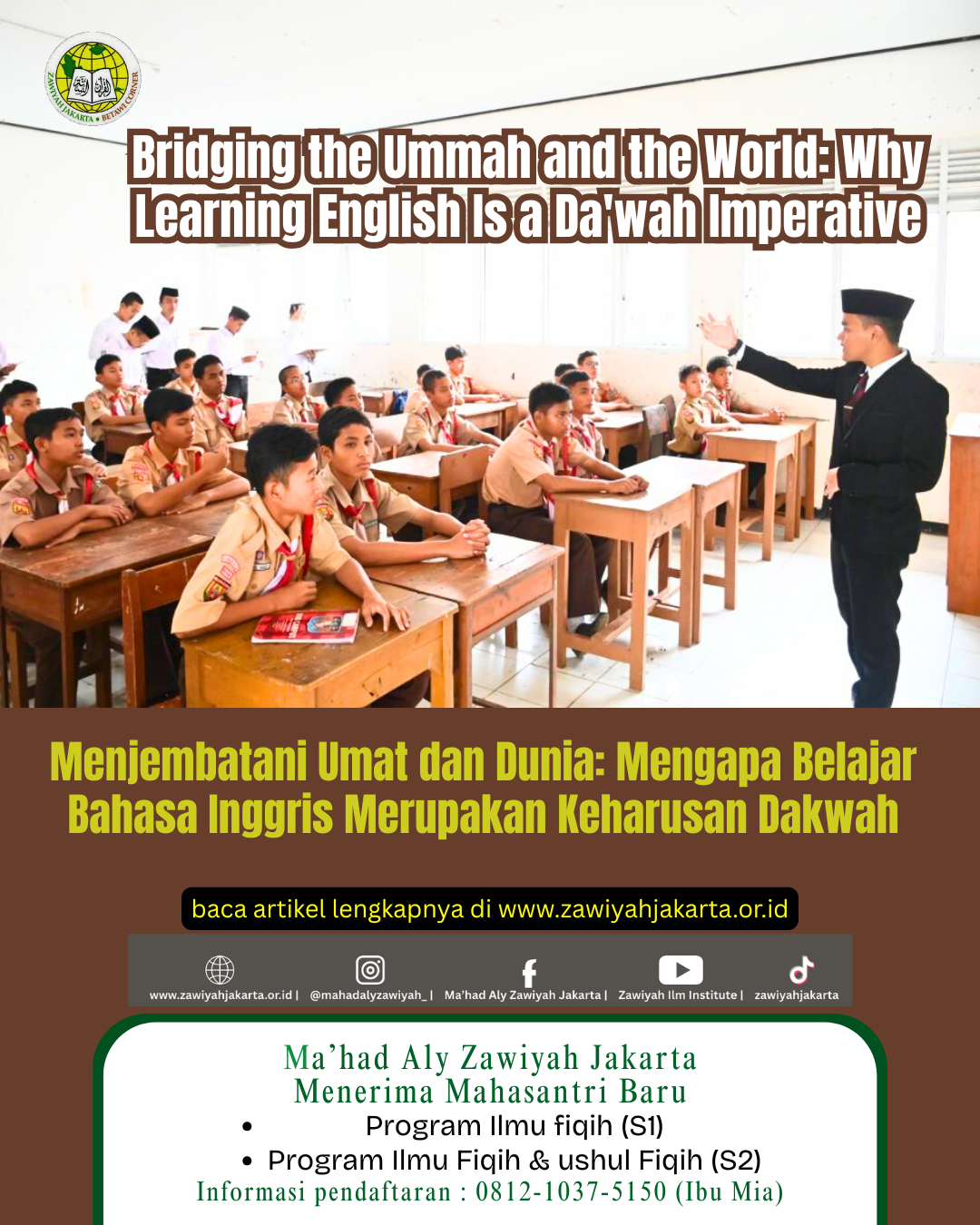
“Bridging the Ummah and the World: Why Learning English Is a Da’wah Imperative”
In the 21st century, the Islamic ummah finds itself at a crossroads. While the global Muslim population exceeds 1.9 billion, its voice is still largely absent from dominant global narratives—particularly in education, media, international diplomacy, and global discourse. One of the often-overlooked causes of this marginalization is linguistic isolation. Despite the growing need for global communication, many Muslims have yet to fully embrace English—the current lingua franca of the world—not only as a tool for education or employment, but as a strategic asset for da’wah (Islamic propagation), cultural representation, and defense of Islam against misrepresentation.
*The Historical Disconnect: Why Muslims Have Been Hesitant*
Historically, Islamic civilization led the world in science, philosophy, and linguistics. The Islamic Golden Age (8th–13th centuries) saw Arabic as the language of scholarship and global thought, influencing Europe through translation movements in Spain and the Crusader states. However, with the decline of Muslim empires and the rise of European colonialism, Western languages, especially English, came to dominate international discourse.
For many Muslim communities, English became associated with colonialism, cultural imperialism, and the erosion of Islamic identity. This historical trauma led to a deep-seated suspicion toward Western languages, especially English. Learning English was seen not merely as a linguistic pursuit but as a betrayal of cultural and religious heritage. Unfortunately, this resistance created a linguistic and ideological vacuum, allowing non-Muslim voices to dominate the global narrative about Islam, often with distortion and prejudice.
*Why This Must Change*
In the contemporary world, language is power. English is the language of international law, diplomacy, science, media, internet, and academia. More than 60% of online content is in English. The most influential platforms—Google, YouTube, academic journals, United Nations reports—operate predominantly in English. If Muslims do not engage with these platforms in their language, they risk being spoken about rather than speaking for themselves.
As Muslims, we carry the responsibility of conveying the message of Islam (da’wah). The Qur’an says:
> “Invite to the way of your Lord with wisdom and good instruction, and argue with them in a way that is best.”
(Qur’an, 16:125)
Wisdom and effective communication are key to da’wah. In a globalized world, English is not a luxury; it is a necessity. The Prophet Muhammad (peace be upon him) even encouraged learning foreign languages. Zayd ibn Thabit, one of his scribes, was ordered to learn Syriac and Hebrew to communicate with non-Arabic speaking tribes. If English had existed then, would the Prophet not have asked someone to learn it?
*English as a Tool for Da’wah, Unity, and Representation*
The modern world is not only interconnected but also ideologically contested. Islam is often misunderstood or misrepresented in English media. Without Muslim voices articulating the beauty of Islam in fluent, confident English, misconceptions persist. Learning English allows Muslims to:
Defend Islam intelligently and articulately in global forums.
Participate in interfaith dialogue and build peace across religious boundaries.
Produce academic content about Islam that reaches the non-Muslim world.
Create media content, such as videos, podcasts, and blogs, that share Islamic wisdom with global audiences.
Bridge communities, especially for Muslims living as minorities in non-Muslim countries.
*The Global Da’wah Challenge*
Imagine the impact of Muslim scholars, thinkers, artists, and leaders who can speak eloquently in English on platforms like TED Talks, BBC, Al Jazeera English, or Oxford Union. Da’wah in the modern age is not only on the pulpits of mosques but also in podcasts, documentaries, YouTube shorts, Instagram reels, academic journals, and intergovernmental reports.
If non-Muslims are studying Islam in English, reading the Qur’an in English translations, and writing about Islamic law and ethics in English, shouldn’t Muslims be the authors, not just the subjects, of those narratives?
*Removing the Excuses*
Many still argue: “Why should we learn English when Arabic is the language of the Qur’an?” This is a false binary. Learning English does not diminish our love for Arabic; rather, it complements it. Arabic connects us to the revelation; English helps us share that revelation with the world.
Others claim English is too difficult. Yet millions of Muslims already learn it informally for work or entertainment. Why not align that effort with religious purpose?
*Call to Action: A Linguistic Jihad for the Ummah*
It is time for a cognitive shift. We must reframe learning English as part of jihad bil-lisan—the struggle through the tongue. Just as we invest in Islamic studies, Qur’an memorization, and Arabic grammar, we should also invest in mastering English—not for worldly gain alone, but for representing Islam globally.
We need Islamic boarding schools, pesantren, and universities that embed English in their curriculum with the vision of da’wah. We need Muslim public speakers, authors, filmmakers, and scholars who can speak to the world in a language it understands.
As Sheikh Hamza Yusuf once said, “It is a crime for Muslims not to master the language of the age.”
*Conclusion*
The Muslim ummah has the message. What it often lacks is the medium. In the modern era, English is one of the most powerful tools available for shaping minds and influencing hearts. Let us not shy away from it. Let us own it, refine it, and use it to fulfill our divine duty.
Let us speak Islam to the world, not just in Arabic or our mother tongues, but in the universal tongue of today.
> “The ink of the scholar is more sacred than the blood of the martyr.”
— Prophet Muhammad ﷺ (reported in various hadith compilations)
Today, that ink may be written in English.
*References*
Qur’an 16:125.
Al-Tirmidhi, Hadith on the Ink of Scholars.
Al-Bukhari, Hadith about Zayd ibn Thabit learning foreign languages.
Pew Research Center (2021). “The Future of the Global Muslim Population.”
UNESCO (2023). “Language and Education for Sustainable Development.”
Hamza Yusuf (2010). Purification of the Heart (Public Lectures).
Wael Hallaq. (2010). The Impossible State: Islam, Politics, and Modernity’s Moral Predicament.
Ibrahim Kalin. (2011). Islam and the West: Conversations with Leading Thinkers.
#zawiyahjakarta
#learningenglishformahasantri


